How to Verify Your Electrical CoC (And Spot a Fake)
When you buy a house or complete a major electrical installation, getting an Electrical Certificate of Compliance (CoC) isn’t just an administrative checkbox—it is a critical legal requirement.
Unfortunately, unqualified operators frequently issue invalid or outright fraudulent CoCs. As a property owner, if your CoC is invalid, your building insurance could reject a fire claim, and you could face severe civil and criminal liability if someone gets injured.
Here is a straightforward guide on how the law works, why these regulations exist, and how to protect yourself.
The Legal Framework: What is the OHS Act and SANS?
Before looking at the certificate itself, it helps to understand the two legal pillars that govern electrical safety in South Africa. A CoC isn't just an industry preference; it is enforced by national law to protect lives and property.
1. The Occupational Health and Safety Act (OHSA)
The OHS Act (Act 85 of 1993) is the overarching national legislation designed to ensure health and safety in workplaces and everyday environments. Under this Act, the Electrical Installation Regulations explicitly state that no person may offer electrical contracting services or issue a CoC unless they are registered with the Department of Employment and Labour.
Why it matters: The OHS Act gives the CoC its criminal and civil legal power. If an electrical fault causes a fire or injury and there is no valid CoC, the property owner can be held personally liable under national law.
Why is the Department of Labour in Charge of Electricians?
It sounds strange at first. Why does a department focused on employment handle electrical safety? Most people hear "Department of Labour" and think of minimum wage, trade unions, or labor disputes.
The reason comes down to the origin of the law itself: protecting people from workplace hazards.
The law was originally written to protect workers (like electricians, factory operators, and handymen) from being injured or killed on the job by unsafe electrical systems. Because the Department of Employment and Labour (DoEL) is legally tasked with enforcing the OHS Act, they naturally became the regulatory body responsible for registering the people who work on those systems. Over time, this mandate extended from purely commercial buildings to include standard domestic properties, ensuring that any electrical installation is safe for anyone who steps foot inside.
Therefore, the DoEL controls the national database of registered contractors and electricians to ensure that only qualified individuals—who know how to prevent fires and electrocutions—are allowed to touch an electrical grid.
2. SANS 10142-1 and SANS 10421 (The Technical Standards)
While the OHS Act provides the legal teeth, the South African National Standards (SANS) provide the actual rules on how the physical work must be done.
-
SANS 10142-1 (The Wiring Code): This is the foundation of all electrical compliance. It dictates exactly how wires must be sized, how distribution boards must be constructed, and how earthing and bonding must be executed. A CoC is essentially a legal declaration that the installation meets every single requirement in this massive code.
-
SANS 10421 (Specialized Technical Safety): This standard outlines critical regulations for specialized components—such as lightning protection systems and specific safety parameters for distribution boards.
Why it matters: Electricians cannot make up their own rules. If an installation fails to meet the exact codes laid out in SANS 10142-1 or SANS 10421, it is legally non-compliant, and a valid CoC cannot be issued.
What the Law Says About Your CoC
To protect yourself, you need to understand three critical legal rules regarding property ownership and electrical modifications. You can cross-reference these directly in the Electrical Installation Regulations, 2009:
1. The Owner’s Legal Responsibility
-
The Law: Regulation 2(1) explicitly states that the "user or lessor" (the property owner or landlord) is responsible for the safety, safe use, and maintenance of the electrical installation.
-
What it means for you: You cannot pass the blame to a tenant or a previous owner. The national law places the legal obligation squarely on the current property owner to ensure a valid CoC is in place.
2. The 2-Year Rule for Property Transfers
-
The Law: Regulation 7(5) states that a user or lessor may not allow a change of ownership if the Certificate of Compliance is older than two years.
-
What it means for you: A CoC is valid for transfer purposes for up to two years from issuance, provided no alterations were made to the system. The moment a CoC hits its 2-year anniversary, it can no longer be used to legally transfer the property to a new buyer. If the property is sold outside of this period, a brand-new CoC must be issued.
3. Alterations and Supplementary Certificates
-
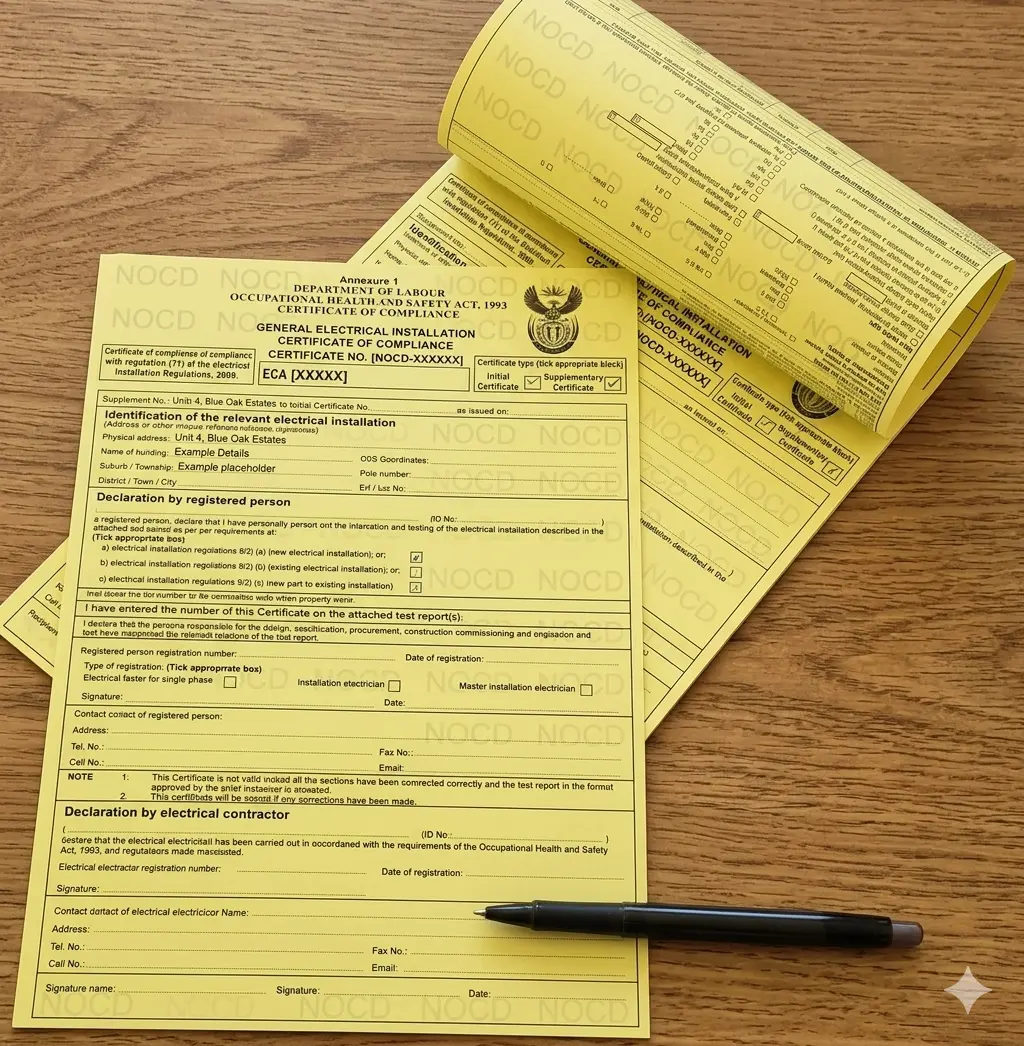
The Law: Regulation 7(4) dictates that if any addition or alteration is made to an electrical installation that already has a CoC, the owner must obtain a Supplementary Certificate (found in Annexure 1 of the regulations) covering that specific new work.
-
What it means for you: If you add a solar system, an inverter, an aircon, or even just add new plug points after your original CoC was issued, the original certificate doesn't cover those changes. A qualified, registered electrician must test the new work and issue a supplementary certificate that explicitly links back to your main, initial certificate.