24/7 Electrical Emergency
Power outage or electrical fault? We're available now across the East Rand.
076 119 1500
COC Certificates
What is a Certificate of Compliance (COC) and when is it required?
A COC is a legal document confirming your electrical installation complies with SANS 10142-1. It is required when selling a property, when applying for a new municipal electricity connection, and after major electrical work. Without a valid COC, property transfer cannot be registered at the Deeds Office.
How long does a COC remain valid?
A COC is technically valid for the life of the installation — provided no changes are made. However, if any electrical work is done after issue, the COC becomes invalid and a new one must be issued. Most banks and conveyancers require a COC issued within the last 2 years for property sales.
What does the COC inspection cover?
Our inspection covers: DB board wiring and labelling, earthing and bonding, circuit breaker ratings, socket and switch compliance, geyser isolation, exterior wiring, and any visible safety hazards. We follow the full SANS 10142-1 checklist.
Can I get a COC for a property that has old wiring?
Yes, but only after all defects are rectified. We will issue a non-compliance report listing what needs to be fixed. Once repairs are completed and pass inspection, we issue the COC. We can handle both the repairs and the final certificate.
Who is legally responsible for issuing a COC?
Only a registered electrical contractor with a valid wireman's licence may issue a COC. It is illegal to self-issue or use an unregistered electrician. NOCD Technical holds the necessary registration and our COCs are fully compliant.
How much does a COC cost?
Cost depends on the size of the property and the extent of work required. A standard residential COC inspection starts from a call-out fee plus the inspection charge. If remedial work is needed, this is quoted separately. Contact us for a specific quote.
DB Boards & Wiring
When should I upgrade my DB board?
Upgrade your DB board if: breakers trip frequently, you experience flickering lights, the board has ceramic fuse holders (old style), you're adding high-load appliances like a geyser or air conditioner, or the board has no earth leakage protection. Old boards are a fire and shock risk.
What is the difference between single-phase and three-phase supply?
Single-phase (230V) is standard for most residential properties. Three-phase (400V) provides three times the power capacity and is used for large homes, workshops, and industrial premises. Three-phase allows for balanced load distribution and runs heavy motors more efficiently.
What is an earth leakage breaker and do I need one?
An earth leakage circuit breaker (ELCB or RCD) detects current leaking to earth — usually through a person — and trips within milliseconds. It is legally required in all South African residential DB boards. It protects against electrocution and is essential for wet areas like bathrooms and kitchens.
Can I add extra circuits to my existing DB board?
Yes, if there is space in the board and the main breaker rating allows it. We assess the existing load, available slots, and supply capacity before adding circuits. Sometimes a sub-board or board upgrade is the better solution.
My breaker keeps tripping — what causes this?
Common causes: overload (too many appliances on one circuit), a short circuit (wiring fault), a faulty appliance, or a weak breaker that needs replacement. Do not tape or bypass a tripping breaker — this is dangerous. Call us for a proper fault-finding inspection.
What cable sizes are used for different circuits?
Standard residential: 1.5mm² for lighting, 2.5mm² for socket outlets, 4mm² for stoves, 6mm² for geysers, and 10mm² or larger for mains feeds and sub-boards. Using undersized cable causes overheating and is a fire risk.
Geysers & Hot Water
Why does my geyser keep tripping the circuit breaker?
Usually caused by a faulty thermostat, a burned-out element, or the geyser overheating. It can also be caused by undersized wiring or a weak breaker. Do not keep resetting it without investigation — persistent tripping can cause a fire.
How do I know if my geyser element has failed?
Signs include: no hot water despite the breaker being on, unusually high electricity bills (element shorted), or a burning smell. We test element resistance with a multimeter. A standard geyser element can be replaced same-day in most cases.
Is a geyser isolator switch required by law?
Yes. SANS 10142-1 requires a dedicated isolator switch within sight of the geyser for safe maintenance isolation. If your geyser lacks one, this will cause a COC failure. We install compliant isolators as part of any geyser work.
What is the correct thermostat setting for a geyser?
The South African standard is 60°C — hot enough to kill Legionella bacteria but below the point of causing scale damage to the element. Higher settings increase electricity use and element wear. Lower settings risk bacterial growth.
Can I add a solar geyser or heat pump to my existing geyser?
Yes. We can install solar panels with a retrofit kit on existing geysers, or replace the unit entirely with a solar geyser. Heat pumps run on electricity but at 3–4× better efficiency than a conventional element. Both options reduce electricity costs significantly.
Solar & Backup Power
What size solar system do I need for my home?
This depends on your daily kWh consumption. A typical East Rand home uses 15–25 kWh/day. We perform a load calculation before recommending a system size. A 5kW hybrid inverter with 10kWh battery storage handles most residential needs including critical loads during loadshedding.
What is the difference between off-grid, grid-tied, and hybrid solar?
Off-grid: completely independent, requires large battery bank. Grid-tied: feeds power back to the grid, no backup when grid fails. Hybrid: works with both grid and batteries — the best balance for South African conditions where loadshedding is a concern.
How long will a battery backup power my home during loadshedding?
Depends on battery capacity and your loads. A 10kWh battery powering lights, TV, Wi-Fi, fridge, and phone charging will last approximately 8–12 hours. High-draw appliances like kettles, stoves, and geysers drain batteries rapidly and should be managed separately.
Do solar panels work on cloudy or rainy days?
Yes, but at reduced output — typically 10–25% of peak capacity. Johannesburg's high annual sunshine hours make it ideal for solar. Well-sized systems account for cloudy days in their energy calculations.
What permits and approvals are needed for solar installation?
Grid-tied and hybrid systems connected to the municipal supply require NRS 097 compliance and notification to the municipality. A COC is required for the electrical installation. We handle all compliance documentation as part of the installation.
What is an SPD and is it required for solar?
A Surge Protection Device (SPD) protects your inverter and panels from voltage spikes — especially important in Gauteng due to frequent lightning. We strongly recommend an SPD on both the DC (panel) side and AC (grid) side. It is required for a compliant solar installation.
How long does a solar installation take?
A standard residential hybrid system takes 1–2 days for installation. Larger commercial installations may take 3–5 days. Panel mounting, inverter wiring, battery connection, and DB integration are all completed before handover and testing.
Faults & Emergencies
I have no power — where do I start?
First check: 1) Is your area experiencing loadshedding? 2) Is your prepaid meter topped up? 3) Have any breakers in your DB board tripped? Reset them if so. 4) Check if neighbours have power. If all of the above are fine, call us — the fault may be on the municipal supply cable or your main supply.
What causes lights to flicker?
Common causes: loose connections at the fitting or DB board, a failing lamp or driver (especially LED drivers), overloaded circuits, or a neutral fault on the main supply. Flickering that affects the whole house suggests a main supply issue or a DB board connection fault.
I smell burning from a plug or switch — what do I do?
Warning Switch off the circuit at the DB board immediately and do not use the outlet. A burning smell indicates arcing or overheating — both are fire hazards. Call us for an emergency inspection. Do not attempt to open the fitting yourself.
What are signs of dangerous wiring in an older home?
Watch for: discoloured or scorched outlets, warm switch plates, aluminium wiring (silver-coloured at connections), cloth-insulated cables, circuits without earth conductors, and breakers that trip without obvious cause. Older East Rand homes built before 1990 often have non-compliant wiring.
Why does my earth leakage trip when it rains?
Water ingress into outdoor fittings, conduit, or underground cable joints causes leakage current that triggers the earth leakage breaker. Common culprits: outdoor plug points, pool pump wiring, garden lights, and underground cable faults. We locate and waterproof the fault.
Do you offer 24/7 emergency electrical services?
Yes. NOCD Technical is available 24 hours a day, 7 days a week for electrical emergencies across the East Rand including Brakpan, Benoni, Boksburg, Springs, and surrounding areas. Call 076 119 1500 for immediate assistance.
New Installations
How do I add more plug points to a room?
We run a new circuit from the DB board or extend an existing circuit, depending on load requirements. Outlets are positioned and wired to code. All wiring is concealed in conduit or channelled into walls for a neat finish. A COC is updated after the work.
What is required to install an air conditioner?
A dedicated circuit is required — typically 2.5mm² cable with a 20A breaker for a split unit up to 18 000 BTU. Larger units may need 4mm² and a 25–32A breaker. We size the circuit correctly to avoid nuisance tripping and comply with the manufacturer's specification.
Can you install outdoor lighting and irrigation pump wiring?
Yes. Outdoor installations require IP-rated fittings, weatherproof conduit, and proper earthing. Pump circuits need correctly rated protection. We ensure all outdoor work is weatherproof and compliant with SANS 10142-1.
What is involved in a stove and oven installation?
A freestanding stove requires a dedicated 40A circuit with 6mm² cable. Built-in ovens and hobs are wired separately with appropriate ratings. We supply and install the correct isolator switch and ensure the connection box is compliant. Never share a stove circuit with other appliances.
How do I get a new electricity connection for a new building?
We assist with the full process: load estimation, application to the municipality, internal wiring installation, and final COC submission. Municipalities require a COC and sometimes a building completion certificate before connecting supply.
Industrial & 3-Phase
What is 3-phase power balancing and why does it matter?
Three-phase supply has three live conductors. If loads are unevenly distributed between phases, the neutral conductor carries excess current, causing voltage imbalance, overheating, and equipment damage. We measure and redistribute loads to achieve balanced phases, protecting motors and sensitive equipment.
Do you do motor control centre (MCC) maintenance?
Yes. MCC maintenance includes thermal scanning, contact cleaning, torque checks on connections, contactor inspection, and overload relay calibration. We work on DOL, star-delta, and VFD (variable frequency drive) motor control systems.
What causes industrial motors to burn out prematurely?
Common causes: voltage imbalance (even 3.5% imbalance reduces motor life by 50%), single phasing (loss of one phase), overloading, poor ventilation, incorrect VFD settings, and repeated incorrect starts. Proper overload protection and regular maintenance prevent premature failure.
Can you do high-voltage (MV) electrical work?
We work on low-voltage (below 1000V) installations. For medium-voltage (above 1000V) systems, we partner with certified MV contractors and can project-manage the work. Contact us to discuss your specific requirements.
EV Chargers & CCTV
What type of EV charger should I install at home?
For residential use, a Level 2 (AC) charger (7kW or 11kW) is the most practical choice. It charges most EVs overnight. We install wall-mounted chargers with load management to prevent tripping your main breaker. A dedicated circuit of at least 32A is required.
Will an EV charger overload my home's electrical supply?
Not if correctly installed. We perform a load assessment before installation to ensure your supply can handle the additional demand. Where necessary, we recommend smart chargers with dynamic load management that reduce charging speed during peak household usage.
What cameras do you install for CCTV?
We install IP (network) and HD-CVI/TVI cameras for both residential and commercial applications. Systems include remote viewing via smartphone app, motion detection, night vision, and cloud or local NVR/DVR recording. We design the camera layout for maximum coverage.
Do CCTV systems work without internet?
Yes. Local recording to an NVR or DVR works without internet. Remote viewing and cloud backup require an internet connection. We configure systems for local-only operation if preferred, or hybrid setups with both local and remote access.
Technical Glossary
What is SANS 10142-1?
The South African National Standard for the wiring of premises. It is the legal requirement for all electrical installations in South Africa to ensure safety against fire and electric shock.
What is Thermal Imaging (IR) in electrical work?
A diagnostic technique using infrared cameras to detect heat radiation. It identifies loose connections or overloaded circuits before they cause equipment failure.
What is Phase Balancing?
The process of distributing electrical load equally across a 3-phase supply. Proper balancing prevents 'neutral current' buildup and ensures motors run efficiently.
What is a Surge Protection Device (SPD)?
Devices designed to protect electrical installations from voltage spikes caused by lightning. Class 1 SPDs handle direct strikes, while Class 2 handle switching surges.
What is Star-Delta Starting?
A starting method for 3-phase induction motors that reduces the initial high current draw, preventing voltage dips on the local grid.
What is a VSD (Variable Speed Drive)?
An industrial controller that varies motor frequency. It allows for precise speed control and significant energy savings in pump and fan applications.
What is a DB Board?
The central point where the main electrical supply is divided into subsidiary circuits, each protected by a circuit breaker tailored to the wire's load capacity.
What is an Earth Leakage Unit (ELU)?
A safety device that detects small leakages of current to the ground and instantly disconnects the power to prevent fatal electric shocks.
What is Power Factor (PF)?
A ratio representing how effectively electrical power is being used. A low power factor results in 'wasted' power and higher utility penalties for factories.
No questions match your search.
Visualizing the Concepts
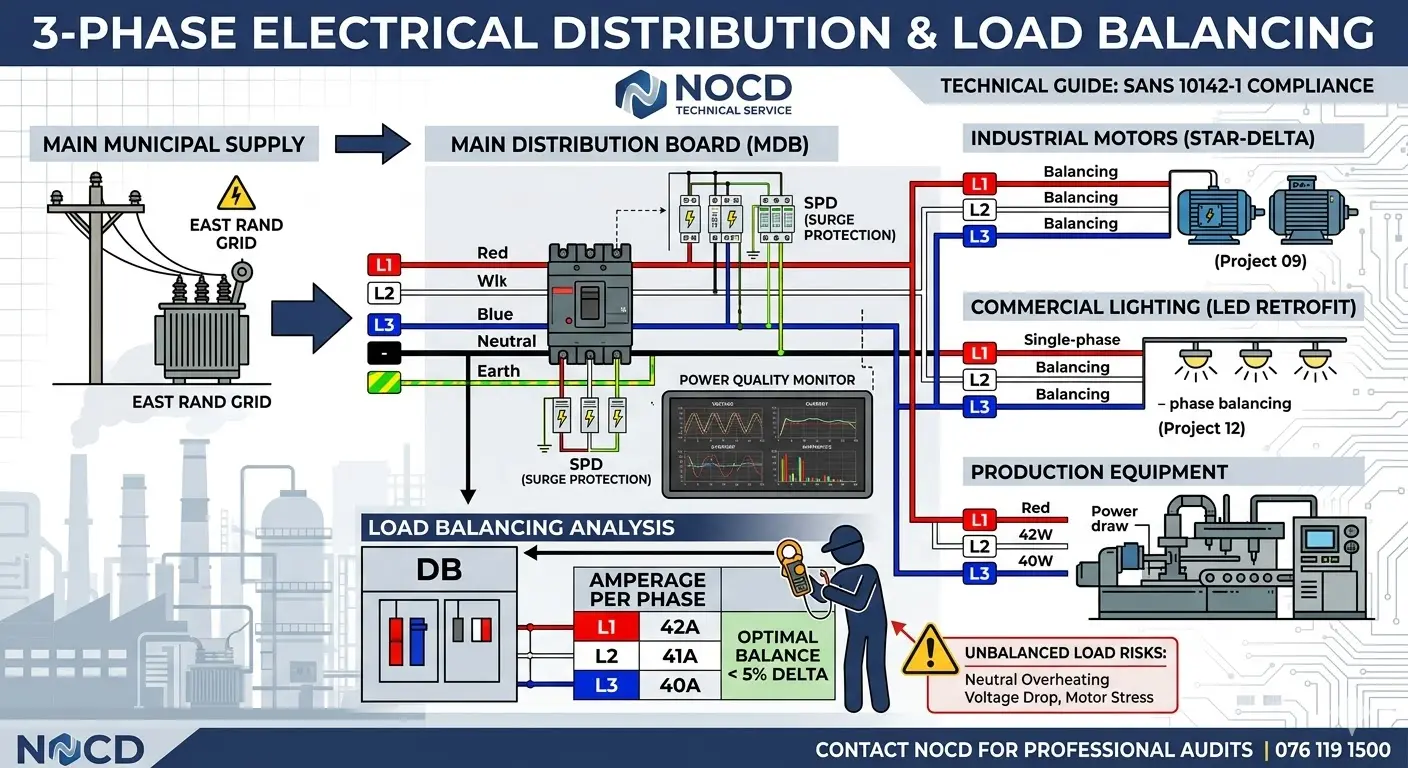
3-Phase Distribution & Balancing
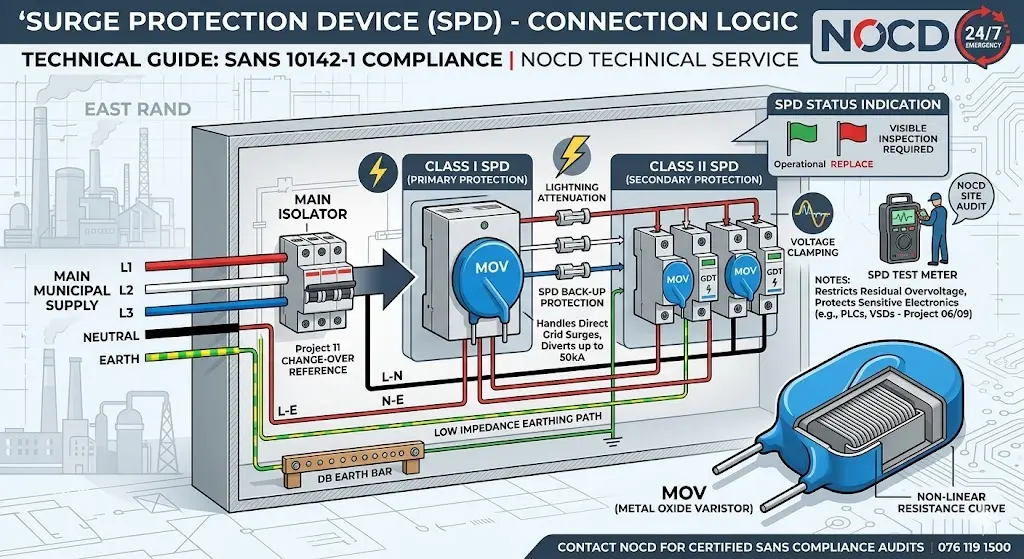
Surge Protection Device (SPD) Logic
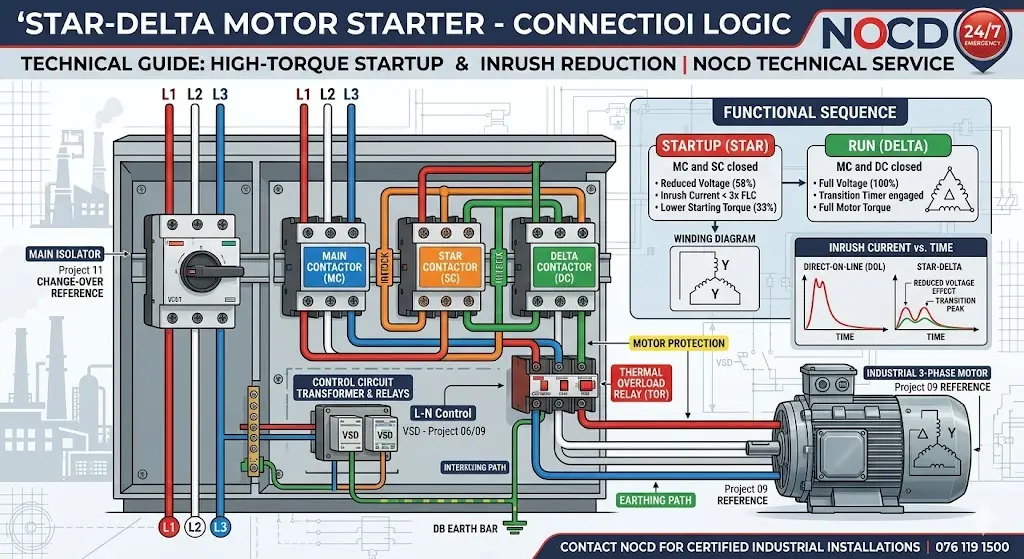
Star-Delta Starter Circuit